
The Spoonie Meal Hack
How to Cook When You Have No Energy
Ever have those days when cooking feels like ‘just too much’?
Still knee-deep in my Interior Design & DIY cycle, my brain just can’t be bothered with trivial ‘nonsense’ like cooking.
Add to that a double dose of pain and fatigue from a lovely, but exhausting family outing that had me take out a giant loan on next month’s spoons, and cooking becomes an almost insurmountable task.
And yet… I still have to eat. That’s where my Spoonie Meal Hack, my simple low-energy cooking method for people with chronic illness, fatigue, or brain fog, comes in handy.
No braining required. No planning, no grocery shopping, no following step-by-step instructions. This low-effort dinner formula turns random fridge findings into a healthy and tasty homemade meal with almost no planning or effort.
What Is the Spoonie Meal Hack?
The Spoonie Meal Hack is a simple low-energy cooking system that helps you build meals even on days when fatigue or brain fog makes cooking difficult.
Recipes (even my own spoonie-friendly ones) can be overwhelming:
- First, there’s the decision fatigue: which recipe shall I choose today? I like this one, but also that one, and…
- But what if I don’t have all the right ingredients?
- Do I have enough spoons to spare?
- And what if brain fog makes me mess up?
These are very real concerns, to which not even I am immune—though I sure wish I were. That’s why we need a system. A no-recipe meal hack that will help us get food on the table even when we can’t brain. Even when we’re living on borrowed spoons.
Thankfully, accessible cooking need not be hard. That why I’m sharing this spoonie meal hack with you. Because it has saved my sanity (and my wallet) time and again.
The Meal I Cooked on Borrowed Spoons
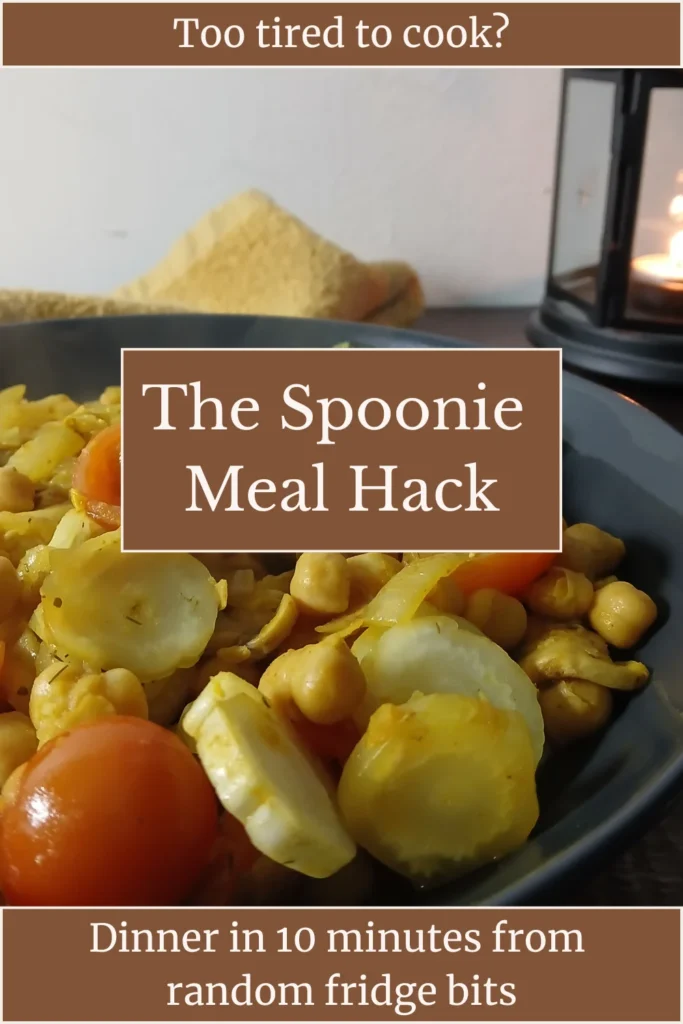
I chopped up an onion, and while that was in the frying pan, I took inventory of what was in my fridge that needed using up: chickpeas, cherry tomatoes, mushrooms, Belgian endives.
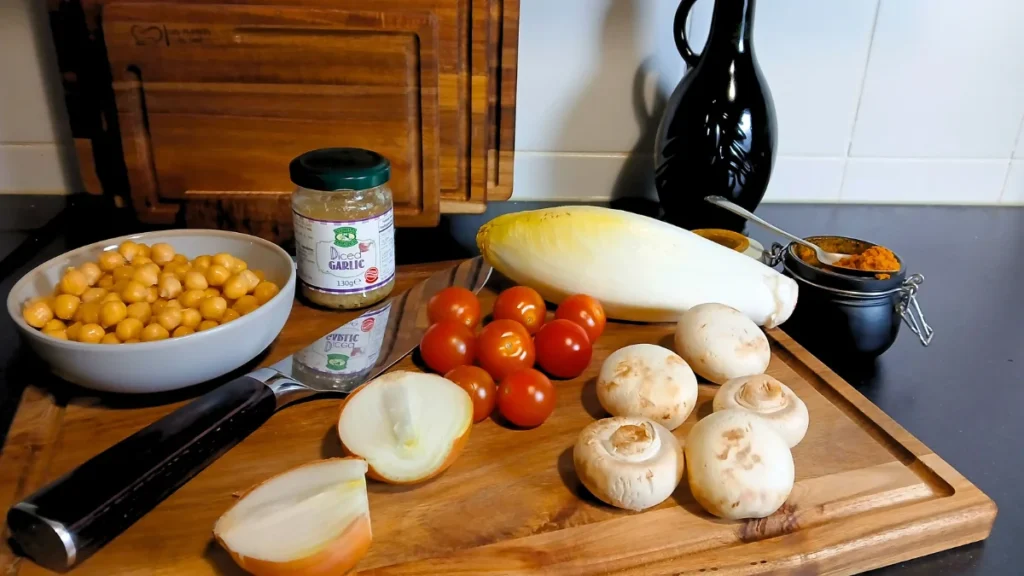
I drained the chickpeas, chopped up the mushrooms and endives, halved the cherry tomatoes, and added all of them to the onions. Mushrooms first (with some chopped garlic from a jar), chickpeas next. Then Belgian endives, and finally the cherry tomatoes.
Seasoned with my homemade dry tikka masala mix, dill, and finally a splash of lemon juice (from a bottle—not the cheap concentrated stuff, which tastes vile, but organic real lemon juice).
And you know what? It tasted like culinary heaven.
But… Belgian Endives and Tikka Masala? For real?
Yes. For real.
Here’s why this combination worked so well.
The chickpeas and mushrooms are earthy and umami: a perfect base for pretty much any vegan dish. Cherry tomatoes add sweetness and moisture, and Belgian endives provide a slight bitterness—and tikka masala and bitterness? That’s a match made in heaven.
The onion and garlic add flavour, and the dill adds a sweet touch. The lemon, finally, is the finishing touch: Fresh, zesty and vibrant.
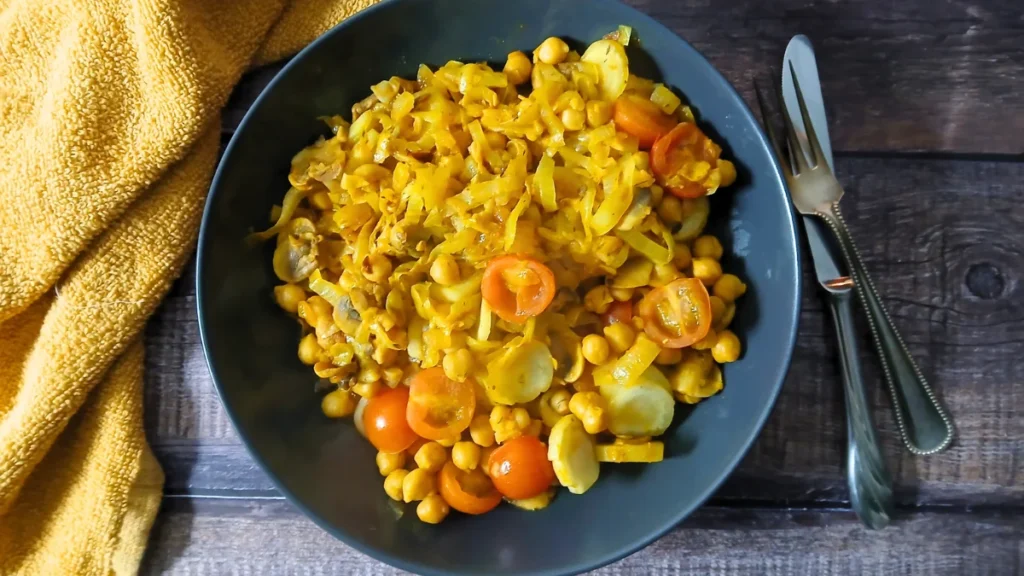
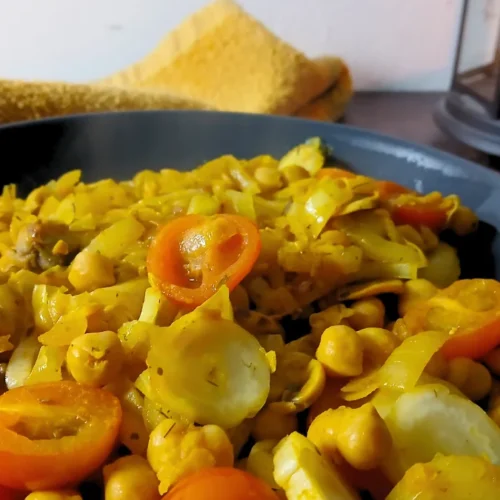
Was it gourmet? Maybe not, but it certainly was good. It looked nice, tasted amazing, and provided all the essentials of a balanced meal: carbs, protein, veg, fibre. A low-effort dinner in under ten minutes. That’s what I call accessible cooking.
Step-by-Step Low-Effort Dinner Formula
Spoonie Meal Hack
Equipment
- Frying pan
- Wooden spoon or spatula
- Chopping board
- Kitchen knife
Ingredients
- Olive oil or other cooking oil
- Onion chopped
- Garlic diced (from a jar)
- Vegetables any
- Legumes any
- Seasoning of choice
- Acid e.g. lemon juice, vinegar, wine
Instructions
- Heat Olive oil in a frying pan.
- Chop an Onion. Start it cooking.
- While the onion softens, look in the fridge.
- Chop whatever Vegetables needs using. Add.
- Now is also the time to add Garlic.
- Add a cup of Legumes.
- Add Seasoning of choice.
- Finishing touch: add a splash of Acid
Notes
- Cherry tomatoes going soft? In.
- Mushrooms slightly wrinkly? In.
- Half a pepper? In.
- Random spinach? In.
Fast & Flavourful Variations
The nice thing about this method is that you can vary to your heart’s content. No matter which ingredients you have on hand, you can make a tasty, nourishing dish using this spoonie meal hack.
Here are some directions you could take.
Italian style
This is one of my personal favourites. It brings back happy memories of the meals shared with our Italian neighbours.
Got tomatoes, courgettes, and bell peppers on hand? These work wonderfully in this dish. Use cannellini beans instead of chickpeas for an even better result.
Season with basil and freshly ground black pepper, add a splash of balsamic vinegar (or even some sour red wine) and you’ve got a dinner that tastes like a Mediterranean dream.
Indian style
Another favourite, one that reminds me of the meals we enjoyed with our Afghan friends.
For this one, I recommend using lentils, and vegetables like cauliflower, carrot, and spinach or Swiss chards.
Season with your favourite curry powder, garam masala, or a tikka masala and finish with lemon or lime. Serve with a few spoonfuls of (plant-based) yoghurt on top.
Northern-European style
Of course, the list is not complete without a Northern-European style variation.
This one works well with red kidney beans, French lentils, or kapucijners (Dutch brown peas; also called ‘raasdonders’, which could be translated as ‘raging thunder’—and I’ll leave it up to your imagination as to why they might be nicknamed thus 😆).
For veggies I’d use mushrooms, carrots, turnips, diced swede, cabbage… And if you’re a meat-eater, some bacon would be nice here.
Season with thyme, caraway, or simply salt and pepper. Finish with apple-cider vinegar, and serve piping hot.
Seasonal variations
Spring is the perfect time to add fresh greens to this low-effort dinner: green beans, baby spinach, leeks, spring onions, pak choy, kohlrabi. In summer, you’ll probably have a surplus of tomatoes, courgettes, and peppers to work with, and come autumn… well, what better way to use up those pumpkins? Then, when winter comes around, there’ll be kale, cabbage, and all these other lovely, hearty vegetables that make my little chef’s heart sing.
As you see, this method is incredibly versatile. One framework. Half a million ways to make your own variations. There is no right or wrong here. Experiment, have fun, and above all: keep yourself fed—the spoonie way.
Spoonie Notes
This method’s versatility is only part of the story. What makes this The Ultimate Spoonie Meal Hack is the fact that no matter how few spoons you have, you can (almost) always fall back on it.
Brain fog won’t make you mess up, because honestly, it’s pretty tough to screw up when all you have to do is throw some random fridge bits in a frying pan and call it supper.
There’s no complicated timing, no sink full of kitchen utensils, nothing of the kind. Just one frying pan and a wooden spoon. And if you’re cutting up some veggies, you’ll need a knife and a cutting board—but when you’re really low on energy: there’s always the option to use frozen veg. And there’s nothing wrong with that.
With that in mind, let’s have a look at a few tricks that have helped me get the best out of this method, even when I’m living on borrowed spoons.
Tips & Tricks
First of all, and this should be a no-brainer, there’s nothing wrong with sitting down while preparing food. As a wheelchair user, I do it all the time. But you don’t have to be a wheelchair user to be allowed to sit down, you know? If you’re tired, dizzy, in pain—or even simply trying to conserve energy… these are all valid reasons to sit down.
Using pre-chopped (frozen) vegetables, beans from a tin, garlic paste from a jar (or even garlic powder)… convenience food is there for your convenience. Use it. That’s not laziness. It’s self-care.
Chopping just a few vegetables? With some luck, you may not even need a cutting board. I often just cut my spring onions straight into the pan—and I actually use scissors for that. Fast, easy, safe.
To help with the ‘blank-brain moments’, there’s what I’d call staggered cooking: just start with the onion, and once that’s softening, have a look in your fridge (or freezer) and decide on what’s next.
And let’s not forget about using the lid. Strategically. I typically place a lid on my frying pan between each step. This traps steam, which means less stirring and more even cooking.
Finally, if you’ve got a large enough frying pan and enough random fridge bits, cook twice what you need. Cook once, eat twice.
What makes this low-effort dinner work
Sure, this easy spoonie dinner may not get any Michelin stars—and no beauty prize either (though you might be surprised at how appetising it can look), but it will fill your stomach. You’ll have an honest, home-made, tasty, and nutritious meal with minimal prep.
You won’t have to spend an unholy amount of money on take-away or (worse) go to bed on an empty stomach. That alone makes this meal hack a winner in my book.
But there’s more.
It works pretty much every time. No matter what ingredients you use, as long as you stick to the basics (onion, legumes, vegetables, seasoning, acid), very little can go wrong. And even if this time it doesn’t taste quite as you might have hoped, that’s a learning experience.
Then there’s the convenience of just a few items to wash up afterwards (just one pan, one wooden spoon, and perhaps one knife and a chopping board).
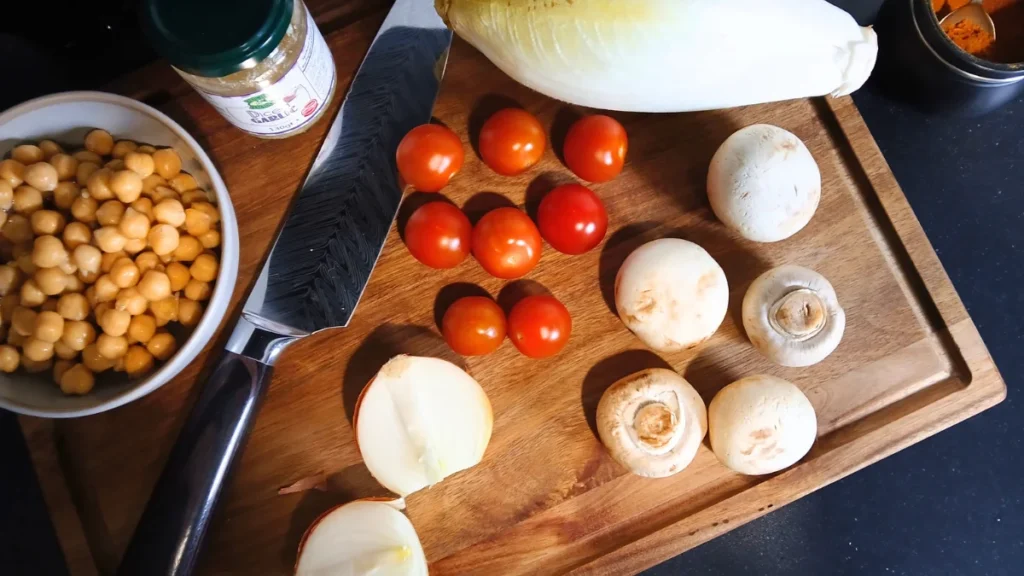
And last but certainly not least: you may just have achieved two important rescues: you saved yourself from starvation, and those random fridge items from ending up in the compost: a double win!
Cooking Without a Recipe
The other day, one of my subscribers told me ‘I am terrible at LOOKING at the fridge and knowing what to make’.
For people like them, the next bit might be the most important part of this post.
I have been cooking since I was little—and I’ve never been very good at leaving a recipe (any recipe, no matter how good) alone. It must be in my genes…
Anyway, cooking without a recipe need not be hard. Cooking on instinct is a skill—and skills can be learnt.
I know, this might be easy for me to say, since I’ve been doing this practically my entire life, but here’s the secret: when I was a child, the changes I made to recipes were tiny. Almost negligible.
Swapped white pepper for black. Milk instead of water. Or maybe I added a spoonful of vanilla to that cake batter—even though it didn’t ask for it.
The more often I did this, the more my confidence grew. And with that growing confidence came more experimenting. Until I was finally creating my own recipes from scratch.
That’s what it’s all about: confidence.
Start small. Don’t get discouraged if something doesn’t turn out the way you hoped for. Simply try again. Remember: every failure is a learning opportunity. A necessary step to success.
A Simple Framework for Hard Days
This spoonie meal hack…It’s not really a recipe. It’s a framework to fall back on when cooking feels overwhelming, when brain fog strikes, or the fridge contains nothing but a few lonely odds and ends.
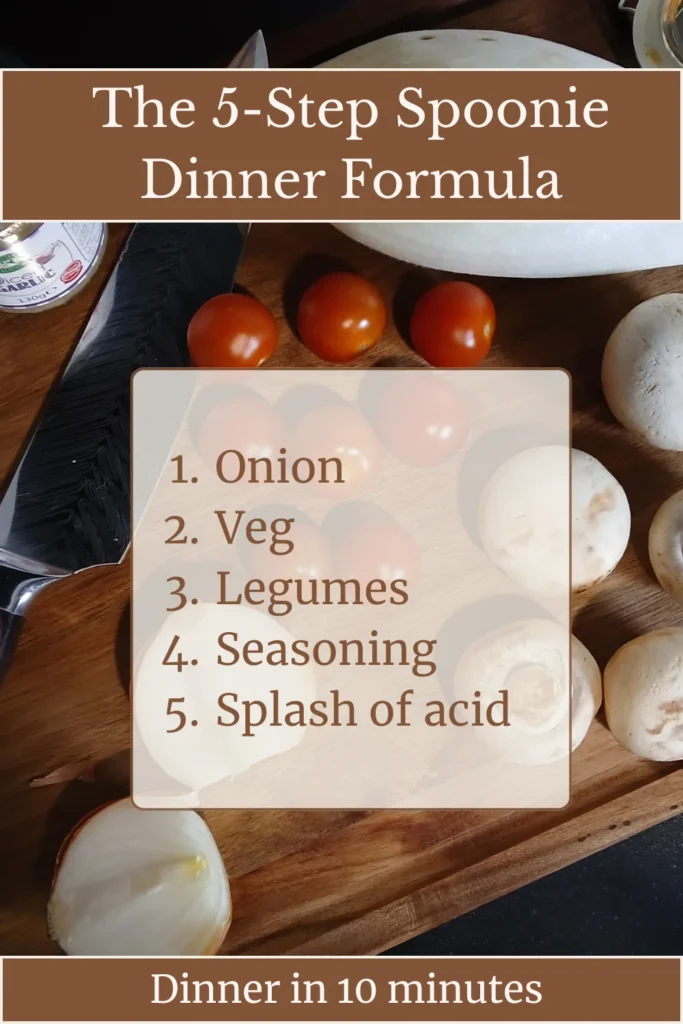
Start with an onion. Add whatever vegetables need using up. Throw in some legumes, season to taste, and finish with a splash of acid. Simple as that.
Some nights the result will be surprisingly delicious. Other nights it will be just OK. Honest food that fills your stomach and keeps you going. Both are fine.
Because on low-spoon days, we don’t care about a perfect meal. We just need a low-effort dinner—preferably healthy and without breaking the bank. This method gives you the tools to achieve that. With only one pan to wash up afterwards.
Like this post? Pin it!

I love this framework so much, and I’m going to figure out how to adapt it for my diet and shopping habits (e. g., I am more likely to have frozen veg than fresh), but there’s one thing I could use some help with if you’re ever inclined to write about it.
The thing I don’t know how to do very well is create spice/flavor combinations. I do have a vague idea of what spices are used in some cuisines, but my range is sadly limited. The way you described how hard it is to do the mental labor of cooking/feeding oneself on hard days is how I’ve felt for over a decade, consistently. I’m never interested in cooking, even though I’m interested in eating, but for a variety of reasons, I have to cook most of the food I eat. So if you ever do feel like writing about how to create interesting and delicious flavor combinations, that would be super amazing and so so helpful. No worries if not, I’m a fellow spoonie and I get it.
Thank you for sharing everything you’ve shared so far, and good luck with your interior design projects!
Thank you for your kind comment, Adrienne. Frozen veg work 100% fine with this method, and actually make everything even easier.
And what a great question! I never thought of writing a blog post about how to create the pleasing flavour combinations (it’s something I typically do by intuition), but it’s actually a fantastic idea, and now I can’t wait to be able to write it. Just have to figure out what my intuition is telling me…