The Low-Energy Kitchen: From Coping to Cooking
Five PM. Time to get supper started, but… the kitchen’s a mess. Dirty dishes, empty packaging, and an assortment of unidentifiable objects are scattered on the worktop. The floor is littered with crumbs. Random objects that don’t belong in a kitchen occupy the table.
My heart sinks. There’s no way I’ll be able to cook supper unless someone clears that mess first. Someone not me, because I’d wipe myself out and still be unable to cook.
Sound familiar?
Why a Low-Energy Kitchen Matters
A clean, tidy kitchen is not a luxury. It’s a necessity, especially for spoonies. When you’re already dealing with pain, fatigue, and brain fog, the last thing you need is a cluttered kitchen. You need to get food on the table. Fast and with minimal effort.
You need a low-energy kitchen. One that supports rather than drains you. But how do you move from coping to cooking—without making your kitchen look like a cold, clinical place? Because, let’s face it, we spend more than enough time in those environments already.
My Spoonie Kitchen Habits
A spoonie home should not just be practical and streamlined, but also warm, welcoming, and beautiful.
Want to know how I achieved that balance in my own spoonie kitchen?
Clear surfaces
A clutter-free kitchen is a must.
Cluttered surfaces are a major energy-drain and an eyesore. According to research, visual clutter impedes information flow in the brain. As a result, thinking and decision-making become harder.
That’s why I prioritise keeping my surfaces clear. This creates a visually calm environment, which helps me keep my act together even when brain fog hits full-force.
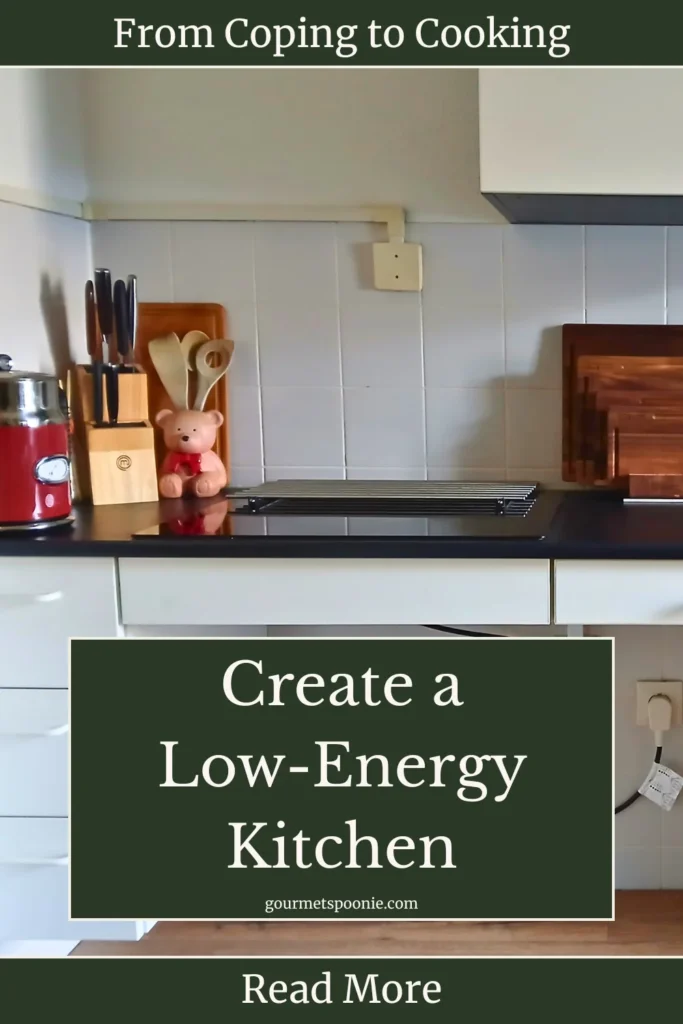
That said, my worktop is never completely empty. I keep a few daily-use items out on display. Besides being useful, this also prevents my kitchen from turning into a cold, clinical space.
These are the things I keep on my worktop:
- wooden spoons in a holder
- knife block
- cutting board
- water cooker
- a trivet
- soap dish with hand soap
- a small cleaning caddy
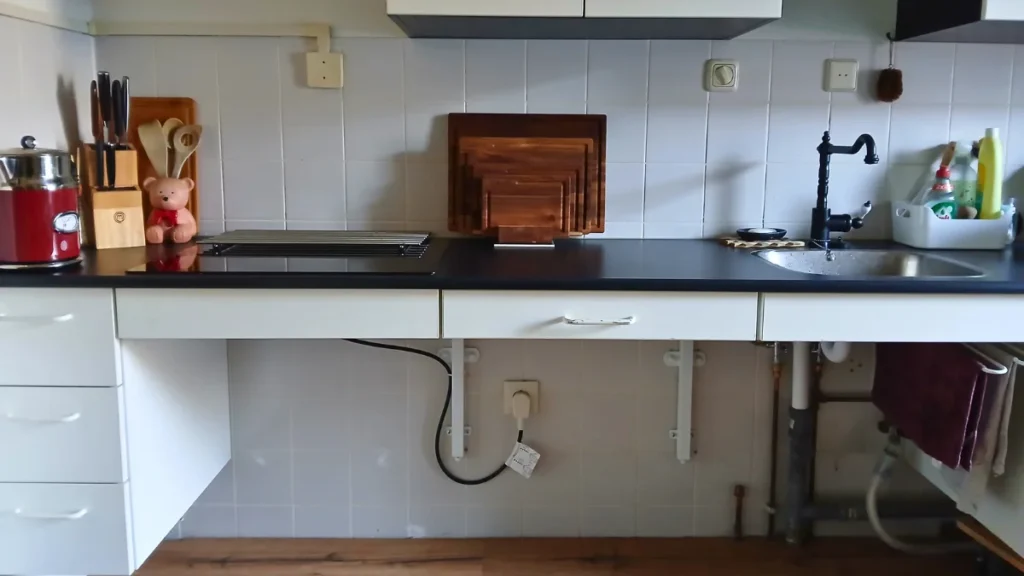
Minimal clutter, maximum mental clarity.
A place for everything
My kitchen is no place for random stuff. If something has no home, I either give it one, or get rid of it.
STUFF:
Scattered Things Undermining Focus and Flow
A low-maintenance kitchen thrives on systems that reduce effort. That’s where the old adage ‘a place for everything and everything in its place’ comes to the rescue.
Because everything in my kitchen has its own home, I never have to wonder where something is. I know its place, and if it’s not there, I’ll find it in the dishwasher.
As an added bonus, it also makes cleaning and tidying faster and less exhausting.
Appliances that make my life easier
In an ideal world, I wouldn’t need any appliances. I’d do the dishes by hand, chop my veggies manually, and cook on an open flame or in the oven.
But I don’t live in Utopia—and accessible kitchen design tailored to my needs includes appliances that healthy people might consider luxuries: dishwasher, slow cooker, Instant Pot, microwave, food processor, to name a few…
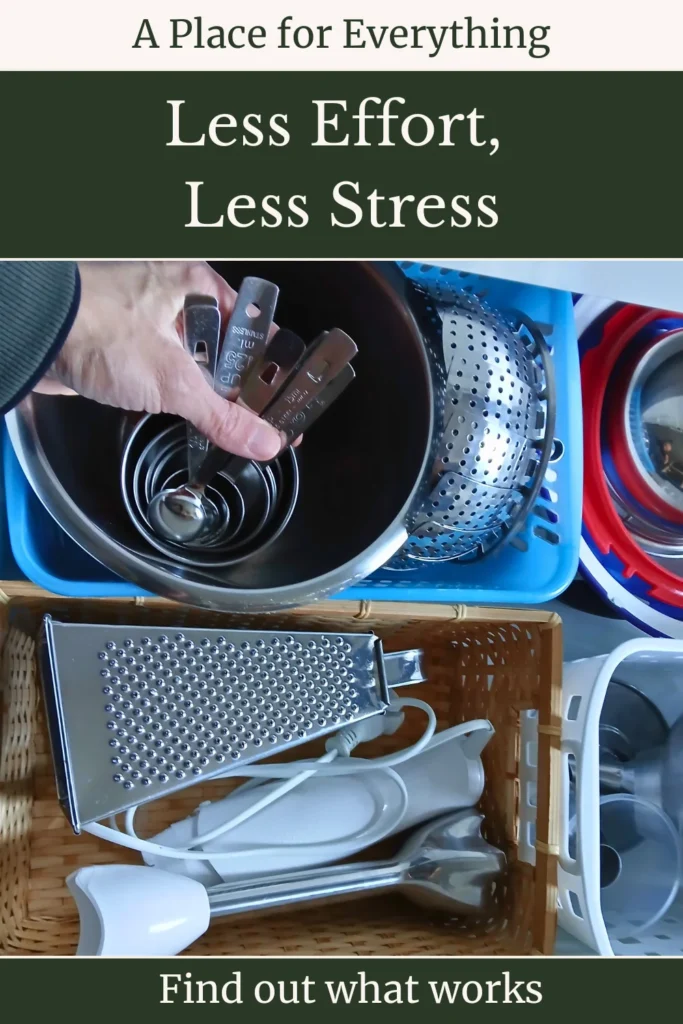
While my dishwasher and microwave live in plain sight, I store my smaller appliances in accessible places, ready to come out the moment I need them.
My roll-under worktop
While I very much prefer the clean look of closed kitchen cupboards, for me as a wheelchair user, accessible kitchen design means I need a roll-under worktop. And, don’t get me wrong: I love it! Without it, cooking would become almost impossible for me.
But those visible pipes, drains, and the unsightly cable running from the hob to the outlet… Ugly! I’d much rather not have to see them. Yet this is the price I have to pay for accessibility.
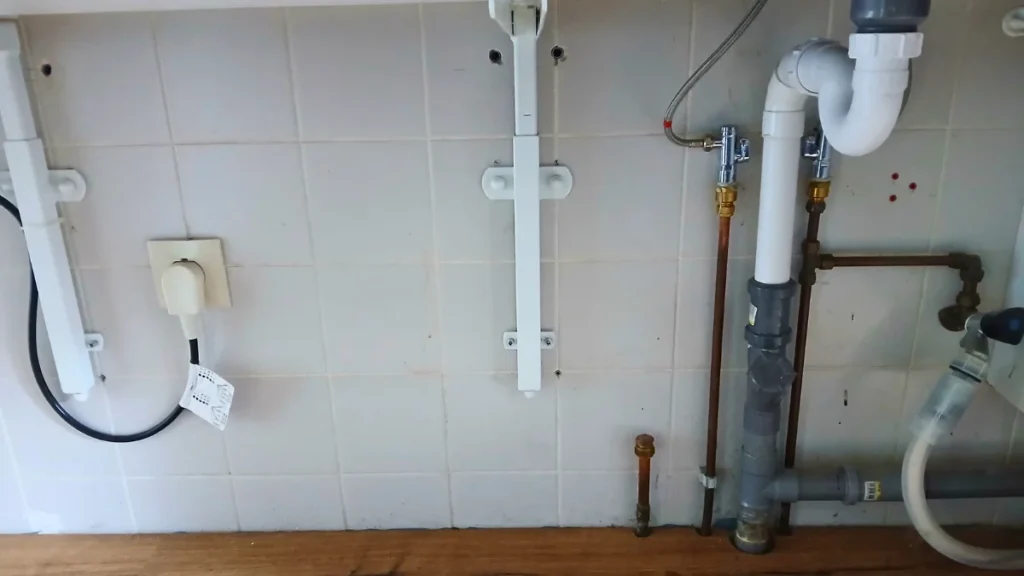
It’s worth it. (And I will be looking into ways to at least hide those eyesores—once the motherlode drops)
Closed cabinets
While I like having nice things on display, open storage in the kitchen tends to get sticky in no time flat, and I don’t enjoy cleaning dust and grime. That, and open storage creates a lot of visual noise.
So, most of my kitchen cupboards are closed. No need to manage how things look behind closed doors. No overwhelm. Easier cleaning.
As for the things I really want to display, I store those behind glass doors: beauty without constant cleaning.
This setup helps me maintain a clutter-free kitchen without much effort.
Drawers over cupboards
You know what’s even better than closed cupboards? Drawers.
Accessible kitchen design should always include drawers, even when you’re not wheelchair-dependent.
Here’s why:
- Easier access
- Less bending and digging
- Everything visible at a glance
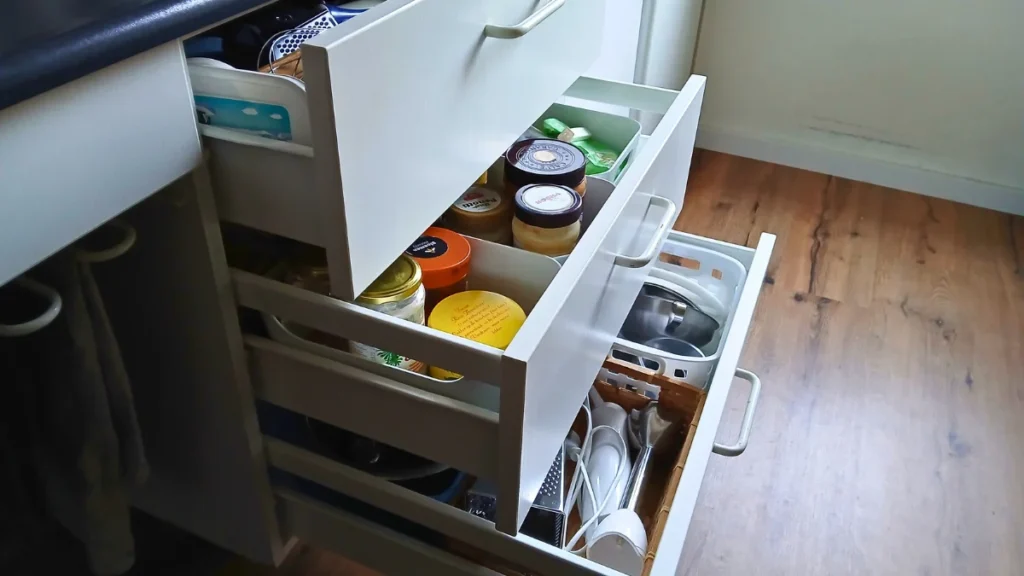
It doesn’t get much better than that, does it?
What does not work
While my kitchen is fully accessible (for me; not necessarily for other wheelchair users), there’s certainly room for improvement.
My ideal kitchen would be even more streamlined than my current one. It would have no visible wires, pipes, or drains, the fridge would be in a more logical place (not at the far end by the window), and my two open cabinets (bookshelves, really) would be replaced with closed storage. Right now, however, I can’t afford a kitchen upgrade, so that’ll have to wait.
But nothing can stop me from dreaming.
Building a Low-Energy Kitchen
A spoonie kitchen is one that works with you, not against you. Mine is already quite spoonie-friendly and only needs some upgrades to become my dream kitchen.
Your situation is different from mine, but no matter what your disability or financial situation, there are things you can do to optimise your kitchen. Take from this blog post what applies to you, and start small.
You don’t need a Pinterest-perfect kitchen. You just need one that helps you preserve energy. Even just clearing your worktop counts. That’s how I started: by just keeping my surfaces clear of clutter.
The rest will follow. One step at a time.
Want more ideas to help you create your perfect Spoonie home?
Sign up for the newsletter and get Spoonie-friendly design ideas straight to your inbox.
Like this post? Pin it!