Accessible Home Library Design
Creating a Gourmet Spoonie Sanctuary
I’ve been quiet lately, and I could blame it on the weather. How the cold makes my body hurt more, how the short days wear me out, the holidays, followed by several winter birthdays… But I’d be lying.
Well, sort of. All of these are true enough, but they’re not the main problem. They’re not even the reason why I haven’t been cooking much and instead survived on holiday/birthday leftovers and convenience food.
The real reason? I’ve been preoccupied with accessible home library design.
Spoonie life and creative cycles
My autistic brain moves in creative cycles, where it becomes obsessed with one particular endeavour at a time—and usually one only.
My main creative cycles are: music, writing & reading, cooking & baking, interior design & DIY, photography, and sometimes even garden design (but please no weeding or anything of the sort). When one cycle arrives, the others fade into the background. Still there, but just less prominent.
Somewhere between the holidays and blowing out the last candle on my birthday cake, the interior design and DIY cycle took over, dictating that I commit to a complete Spoonie home make-over. Now, all I can think about is turning my neglected cat room/music room into a warm and inviting home library/music room/cat sanctuary. One where I can curl up with a good book, a cuppa, homemade chocolate chip cookies, and a cat in my lap. The ultimate spoonie comfort room.
I’m still cooking—only now the ingredients are colour, light, and layout.
Which doesn’t seem very Gourmet Spoonie at first glance. Yet, the more I think about it, the more I realise that maybe it still is. I’m still cooking—only now the ingredients are colour, light, and layout, and my utensils are paint brushes and power tools. I’m still creating something delicious and comforting. Feeding the spoonie soul, which is just as important as feeding the spoonie body.
Because gourmet isn’t always about food. Sometimes it’s about how we create our safe spaces. The ones that nourish our deepest inner cravings.
Spoonie home makeover: the reality
A healthy person could probably pull this entire project off in six months or fewer, but I’m not a healthy person. I’m an autistic, wheelchair-dependent spoonie with hEDS, and there’s no universe where I could do a complete home make-over in such a short time. My spoonie home makeover is going to take years.
And I’m okay with that.
I’ll tackle the project bit by bit, completing sub-projects at a snail’s pace, but I can do this. I’ve got the tools and the skills. I also have an obstinate body. And a chronic lack of funds—another excellent reason to take things very slowly indeed.
Creating a wheelchair accessible home library design
Reading has been one of my great loves ever since I learnt how to spell. In fact, I read so much, one of my primary school teachers once told my parents he could tell how much I read by my vocabulary, which was way more substantial and sophisticated than that of my peers. And yet, I only have two bookcases.
I used to own far more books than my two bookcases could hold. I donated some. Passed my childhood favourites on to my children. Left some behind when I got divorced. But I’m rebuilding. And my growing collection needs a home.
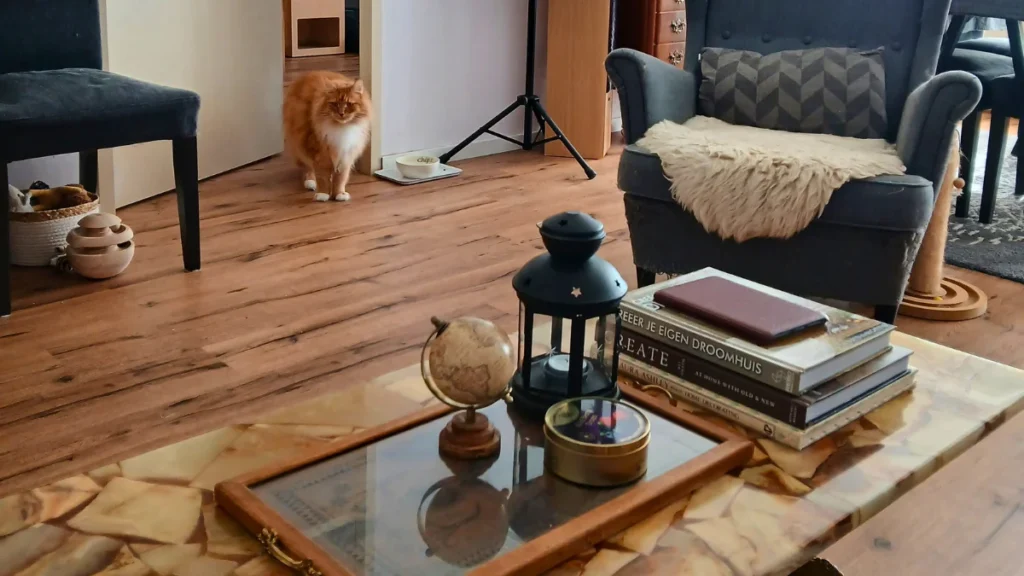
So I decided to start with a wheelchair accessible home library. Luckily, I have this neglected cat room/music room, that currently houses the cat trays and two of my pianos. It’s functional. And totally uninspiring. And the acoustics are dreadful—which is particularly tragic in a music room.
The cats still need their space. The two pianos need to stay. (One antique piano in the living room is quite enough.) This accessible home library design needs to hold all three functions: books, music, and cats. All while still remaining fully wheelchair accessible.
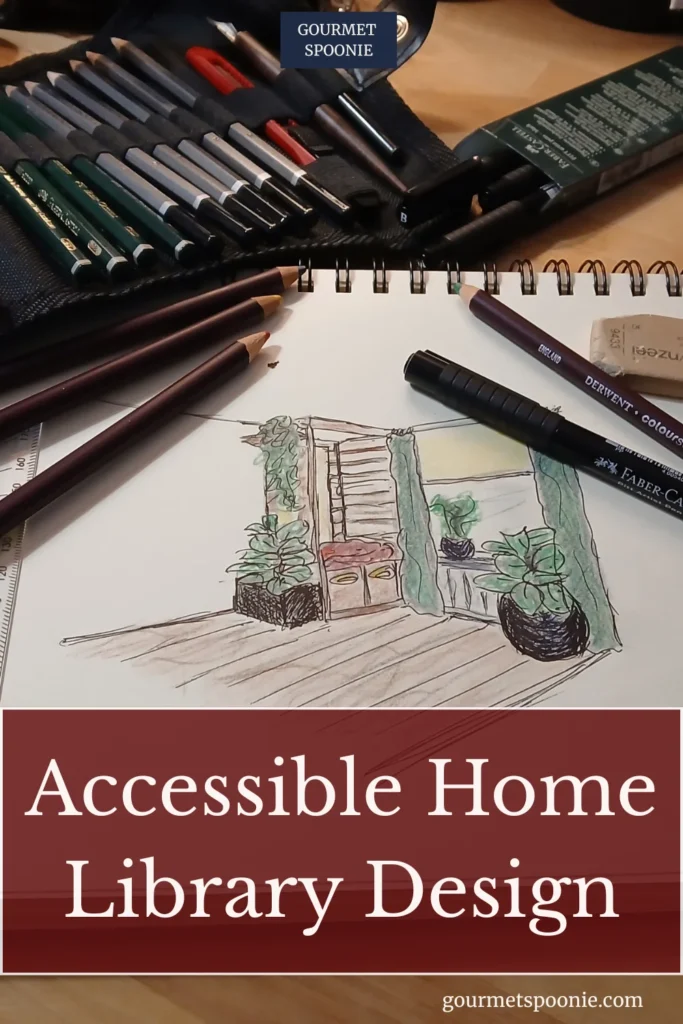
So I did what I always do. I grabbed pen and graph paper and started drafting a layout that would accommodate all three functions without sacrificing wheelchair access.
Of course, I made sure I’ll have ample room to move around in my wheelchair. Because without that, what would be the point?

Designing a cat-friendly, spoonie-friendly room
I designed my cat condo exactly the way I need it to be: with high perches for them, a large jute rug hung on the back to act as a scratching post, a soft cushion for sleeping, and two well-ventilated hidden pull-out compartments for the litter trays.
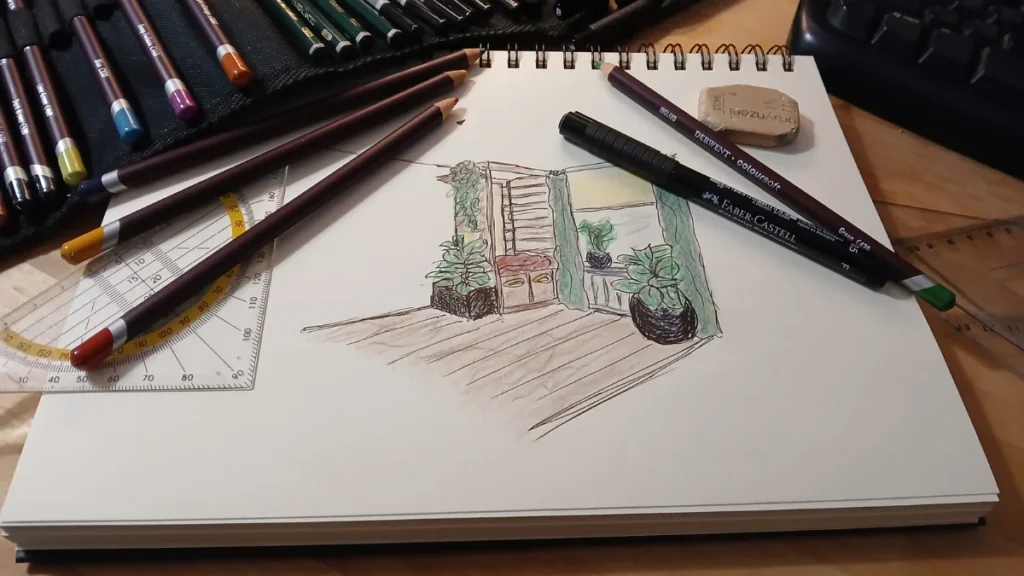
This solution does several things: the cats have their own dedicated space, the trays are hidden from view, odours are less obtrusive, and cleaning will be easy thanks to the pull-out system.
Building a cosy, accessible wall of books
An accessible home library design without bookcases is unthinkable. So, once I have the cat condo in place, I’ll start building my own bookcases, beginning where the condo ends and lining the rest of the wall. I’m not exactly sure of all the details yet, but I do know I want to include a faux fireplace (electrical or alcohol-based) and compartments for my hi-fi system and speakers.
Done this way, my wall of books will give me several things at once: excellent storage (not just for books, but also CDs, DVDs, and cat supplies), a warm, cosy ambiance, and… drastically improved acoustics.
Accessible setup for music and work
My modern Pleyel and electronic Yamaha (great for playing when I can’t sleep but don’t want to antagonise my neighbours) will stay in the room—though both will be moved. The Pleyel only by about half a metre, the Yamaha to a different wall entirely.
Finally, I want to move my desk from the living room to the library. Not only does that make more sense, but it will also allow me to place it right in front of the window, so I get all the benefits of natural daylight while working—and a lovely view of the garden to boot.
While I doubt I’ll have room left for a comfy chair, that doesn’t really matter. I have my wheelchair, after all, so I can sit wherever I want. Problem solved.
Sensory-friendly light and colours
Once I had the layout, there were still two essential decisions to make: light and colour. Because light and colour influence how we feel, which is especially important for spoonies. Perhaps doubly so when you’re an autistic spoonie, because we tend to be extremely sensitive to both.
With that in mind I knew I needed a calm and soothing colour scheme, filtered daylight, and atmospheric light at night, because let’s be honest: those harsh ceiling lights never did anyone any favours.
It’s no secret: I love autumn. And I happen to have this beautiful photo of my Virginia Creeper in its full autumn dress. So I decided to base my colour scheme around those tones.
Warm. Earthy. Autumnal.
Colours that say: you’re safe here.
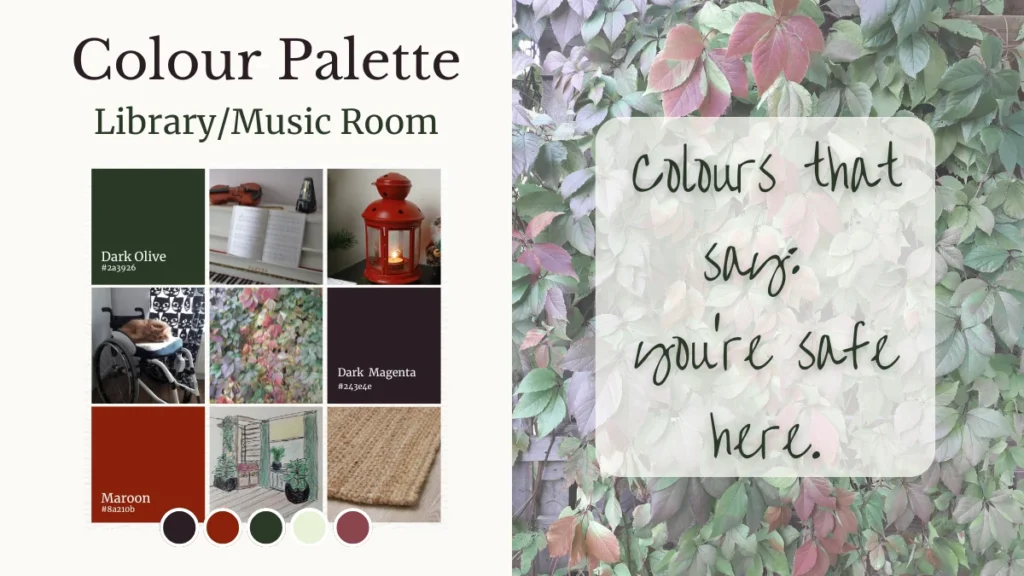
As for lighting: I don’t have the details worked out yet. But I know I want shelf lighting for my bookcases, a tall standing lamp if space allows, wall sconces by the pianos, and a desk lamp.
Gentle, layered light. Light I can adapt to the time of day. And, most importantly, to my energy levels.
A gourmet room, where accessibility meets design
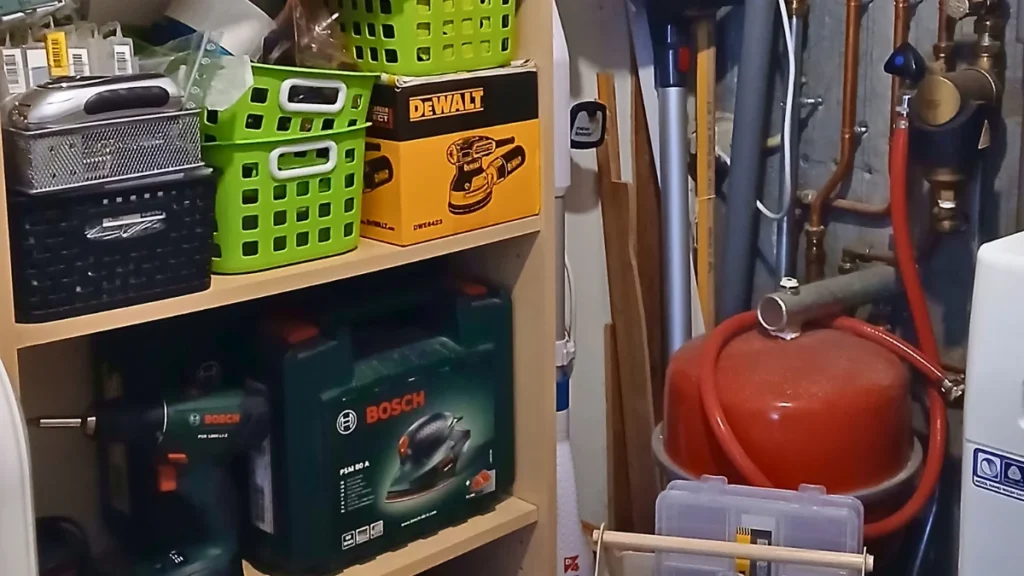
The lumber for the cat condo is already waiting in my hallway photo studio, which happens to be the only place I have for it. Not exactly practical when you still want to cook delicious, spoonie-friendly dishes and take mouthwatering photos of them, but that, too, is spoonie life.

The kitchen cycle will return. It always does—and usually sooner rather than later. I’ll be sharing cakes and crumbles, cookies and biscuits, slow-cooked comfort dishes, lazy oven delights, and of course, my spoonie tips and tales.
For now, I’m designing a room where those recipes will feel at home. A space for cats, music, books, and light that nourishes the spoonie soul as much as the body. A Gourmet Room, built one careful spoonie step at a time. And I can’t wait to share each stage of it with you.
The cat condo might be lumber in my hallway today, but its time will come—and so will mine. One day (in a hopefully not too distant future) I’ll be sitting in my Gourmet Room, enjoying the filtered sunlight, Handel’s ‘Angels, ever bright and fair’, a perfect cuppa, and freshly baked chickpea-cherry brownies.
This accessible home library design doesn’t rely on speed. Sustainability, comfort, and accessibility are key in my spoonie home makeover.
Want ideas to help you create your perfect Spoonie home?
Sign up for the newsletter and get Spoonie-friendly design ideas straight to your inbox.
Enjoyed this post? Pin it!